Naia Spaces
Naia is product decision intelligence. Sustainability rigor is one lens, not the whole story.
That is a real shift, not a tagline change. The old framing, an AI tool that calculates your environmental impact, undersold what actually happens in the room when a team decides what to build. Cost, performance, sourcing, risk, and timeline all get decided alongside sustainability, usually without anyone assembling the full picture first.
Who it is for
Not just the sustainability lead. Head of product, VP engineering, chief design officer, general manager, anyone accountable for a product decision that would be expensive to get wrong.
What it does
Three things, deliberately not a features list:
Frame: assembles the real tradeoffs in a decision, cost, environmental impact, performance and quality, capacity and throughput, sourcing and supply, implementation cost and time, risk and liability, in one place. Nobody does this by hand, there is not time.
Flow: a guided process that turns those tradeoffs into a recommendation a team can act on, not a data dump they still have to interpret themselves.
Auditability: versioned, reproducible output with the method behind it pinned down. Run it again and get the same answer, and see exactly why. A chatbot conversation cannot do that, structurally, no matter how good the model behind it is.
The data plugged into each dimension is the customer's own, graded by how solid it is. The value is the frame, the process, and output that holds up when someone checks it.
The honest part
Not every dimension is equally rigorous yet, and we say so rather than imply otherwise. Environmental impact has real deterministic method and reference data behind it today. The rest combine a structured frame, AI-assisted estimates, and an explicit pedigree on every number: solid, estimated, or needs validating with your team. That distinction gets shown, not hidden. A number that looks precise but is not gets called what it is.
How it reaches a company
Flash first: a fast, directional recommendation, enough to move on with confidence. Decision Sprint after, for decisions big enough to need the deeper, validated version. Either way, it is work done alongside a company's own team, not software handed over and left to figure out alone.
This is Naia now. Not a calculator bolted onto the end of a design process, but part of how the decision itself gets made, for whatever a team is building.
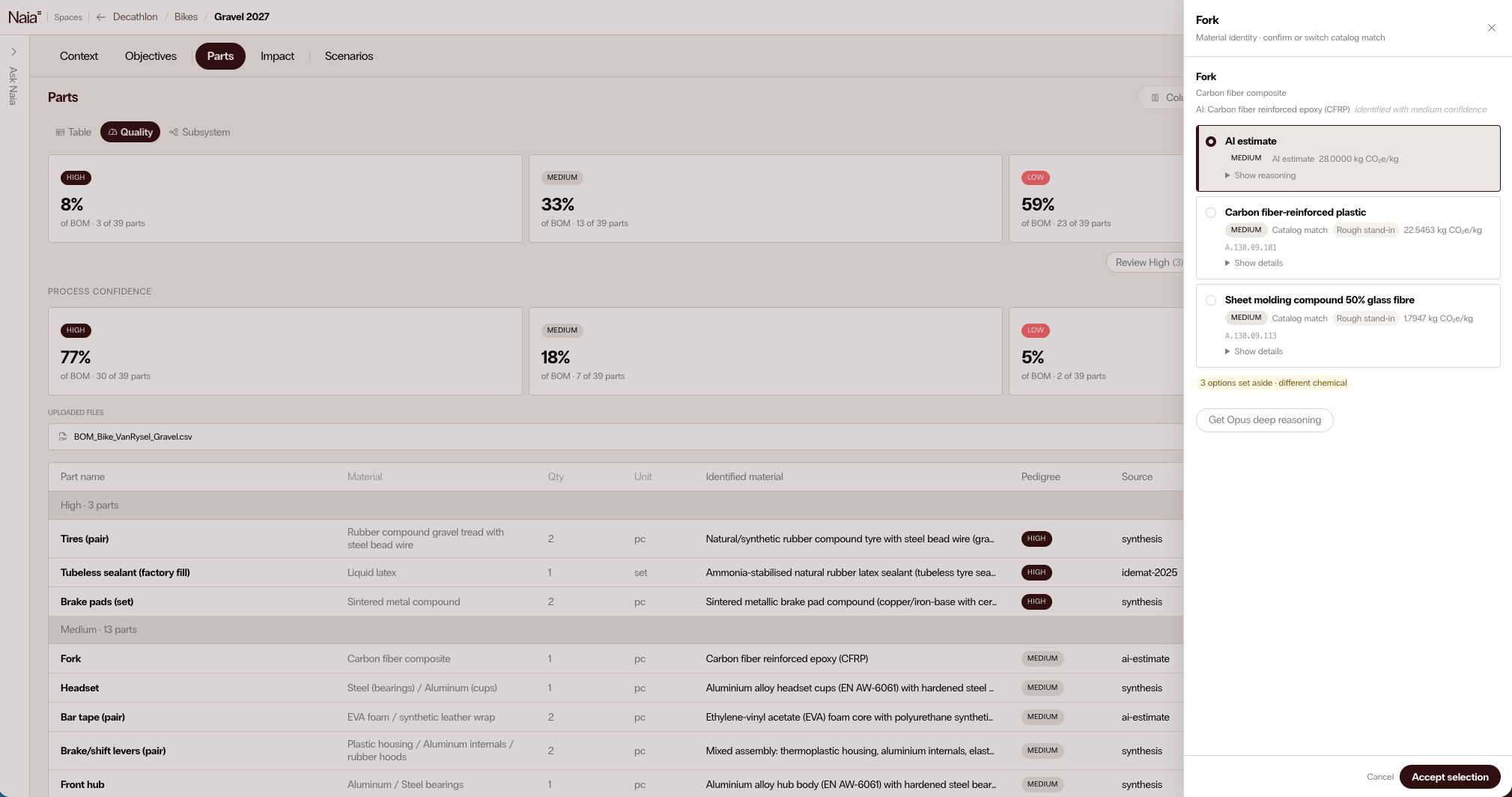
Every part carries a pedigree, tagged by where its number came from: a calculation, a catalog reference, or an AI estimate when nothing better exists yet. An AI estimate never stands alone, either. The system checks the material against the real catalog first and shows what it finds, so a sourced, catalog-matched option sits right next to the model's guess, not in place of it. When the system is not certain, it does not decide quietly. It surfaces every candidate side by side, confidence and source attached, and a person confirms or switches before it locks in. That is the rigor: garbage in, garbage out gets caught here, because nothing is trusted on the model's word alone, and the last call always belongs to a person.
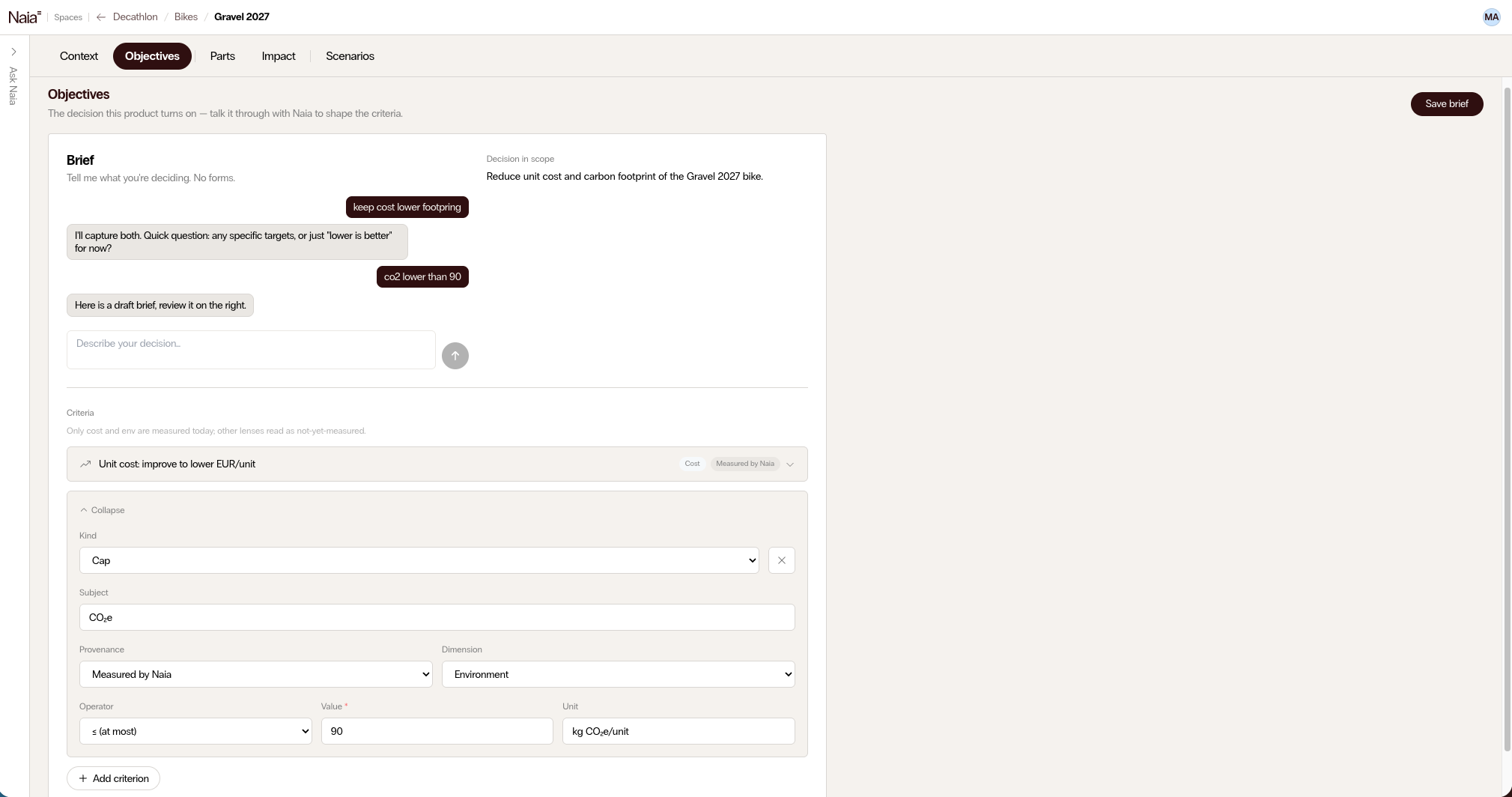
Describe the objective in plain language, for example cap embodied carbon at 90 kg CO2e per unit, and Naia Spaces turns it into a measurable target with the right unit and operator attached. Only cost and environmental impact are measured in this example. Everything else shows as not-yet-measured, not guessed at.
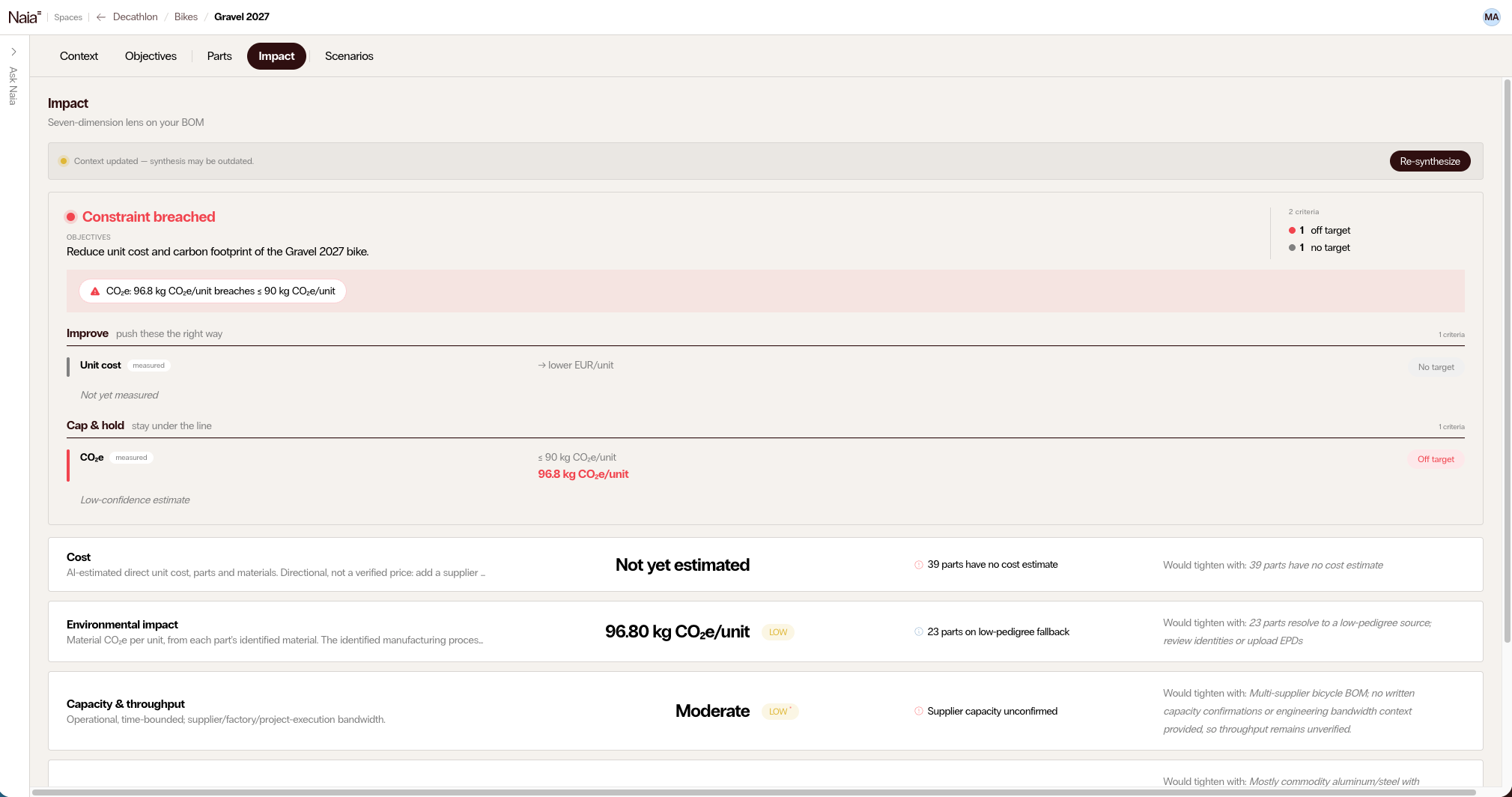
Witjht the context and objectives set Naia Spaces checks the product against it in real time. Every dimension shows exactly what it would take to tighten it: resolve materials with better pedigree, confirm supplier capacity, add a verified quote. Nothing is presented as more solid than it is.